Simply place two superconductors very close to each other, separated by a small gap, and you’ll have taken a big step towards an important piece of technology called a Josephson junction.
When the two superconductors are close to each other and exposed to electromagnetic radiation in the microwave frequency (0.3-30 GHz), a small voltage develops in the gap. As waves from the radiation rise and fall between the gap, so too the voltage. And it so happens that the voltage can be calculated exactly from the frequency of the microwave radiation.
A Josephson junction is also created when two superconductors are brought very close and a current is passed through one of them. Now, their surfaces form a capacitor: a device that builds up and holds electric charge. When the amount of charge crosses a threshold on the surface of the current-bearing superconductor, the voltage between the surfaces crosses a threshold and allows a current to jump from this to the other surface, across the gap. Then the voltage drops and the surface starts building charge again. This process keeps going as the voltage rises, falls, rises, falls.
This undulating rise and fall is called a Bloch oscillation. It’s only apparent when the Josephson junction is really small, in the order of micrometres. Since the Bloch oscillation is like a wave, it has a frequency and an amplitude. It so happens that the frequency is equal to the value of the current flowing in the superconductor divided by 2e, where e is the smallest unit of electric charge (1.602 × 10⁻¹⁹ coulomb).
The amazing thing about a Josephson junction is the current that jumps between the two surfaces is entirely due to quantum effects, and it’s visible to the naked eye – which is to say the junction shows quantum mechanics at work at the macroscopic scale. This is rare and extraordinary. Usually, observing quantum mechanics’ effects requires sophisticated microscopes and measuring devices.
Josephson junctions are powerful detectors of magnetic fields because of the ways in which they’re sensitive to external forces. For example, devices called SQUIDs (short for ‘superconducting quantum interference devices’) use Josephson junctions to detect magnetic fields that are a trillion-times weaker than a field produced by a refrigerator magnet.
They do this by passing an electric current through a superconductor that forks into two, with a Josephson junction at the end of each path. If there’s a magnetic field nearby, even a really small one, it will distort the amount of current passing in each path to a different degree. The resulting current mismatch will be sufficient to trigger a voltage rise in one of the junctions and a current will jump. Such SQUIDS are used, among other things, to detect dark matter.
Shapiro steps
The voltage and current in a Josephson junction share a peculiar relationship. As the current in one of the superconductors is increased in a smooth way, the voltage doesn’t increase smoothly but in small jumps. On a graph (see below), the rise in the voltage looks like a staircase. The steps here are called Shapiro steps. Each step is related to a moment when the current in the superconductor is a multiple of the frequency of the Bloch oscillation.
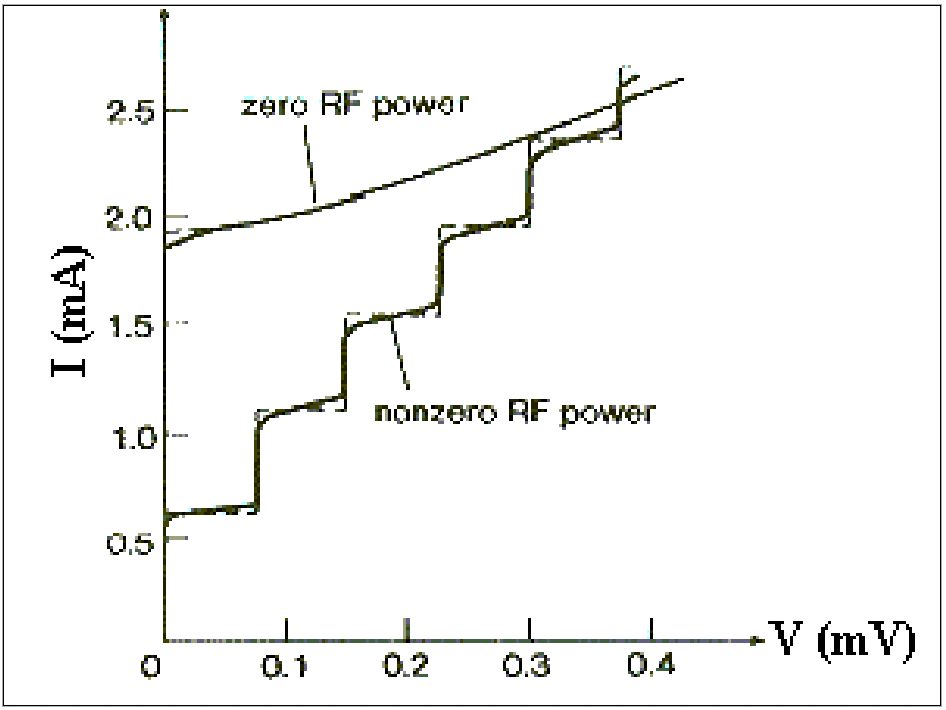
In a new study, published in Physical Review Letters on January 12, physicists from Germany reported finding a way to determine the amount of electric current passing in the superconductor by studying the Bloch oscillation. This is an important feat because it could close the gap in the metrology triangle.
The metrology triangle
Josephson junctions are also useful because they provide a precise relationship between frequency and voltage. If a junction is made to develop Bloch oscillations of a specific frequency, it will develop a specific voltage. The US National Institute of Standards and Technology (NIST) uses a circuit of Josephson junctions to define the standard volt, a.k.a. the Josephson voltage standard.
We say 1 V is the potential difference between two points if 1 ampere (A) of current dissipates 1 W of power when moving between those points. How do we make sure what we say is also how things work in reality? Enter the Josephson voltage standard.
In fact, decades of advancements in science and technology have led to a peculiar outcome: the tools scientists have today to measure the frequency of waves are just phenomenal – so much so that scientists have been able to measure other properties of matter more accurately by linking them to some frequency and measuring that frequency instead.
This is true of the Josephson voltage standard. The NIST’s setup consists of 20,208 Josephson junctions. Each junction has two small superconductors separated by a few nanometres and is irradiated by microwave radiation. The resulting voltage is equal to the microwave frequency multiplied by a proportionality constant. (E.g. when the frequency is around 70 GHz, the gap between each pair of Shapiro steps is around 150 microvolt.) This way, the setup can track the voltage with a precision of up to 1 nanovolt.
The proportionality constant is in turn a product of the microwave frequency and the Planck constant, divided by two times the basic electric charge e. The latter two numbers are fundamental constants of our universe. Their values are the same for both macroscopic objects and subatomic particles.
Voltage, resistance, and current together make up Ohm’s law – the statement that voltage is roughly equal to current multiplied by resistance (V = IR). Scientists would like to link all three to fundamental constants because they know Ohm’s law works in the classical regime, in the macroscopic world of wires that we can see and hold. They don’t know for sure if the law holds in the quantum regime of individual atoms and subatomic particles as well, but they’d like to.
Measuring things in the quantum world is much more difficult than in the classical world, and it will help greatly if scientists can track voltage, resistance, and current by simply calculating them from some fundamental constants or by tracking some frequencies.
Josephson junctions make this possible for voltage.
For resistance, there’s the quantum Hall effect. Say there’s a two-dimensional sheet of electrons held at an ultracold temperature. When a magnetic field is applied perpendicular to this sheet, an electrical resistance develops across the breadth of the sheet. The amount of resistance depends on a combination of fundamental constants. The formation of this quantised resistance is the quantum Hall effect.
The new study makes the case that the Josephson junction setup it describes could pave the way for scientists to measure electric currents better using the frequency of Bloch oscillations.
Scientists have often referred to this pending task as a gap in the ‘metrology triangle’. Metrology is the science of the way we measure things. And Ohm’s law links voltage, resistance, and current in a triangular relationship.
A JJ + SQUID setup
In their experiment, the physicists coupled a Bloch oscillation in a Josephson junction to a SQUID in such a way that the SQUID would also have Bloch oscillations of the same frequency.
The coupling happens via a capacitor, as shown in the circuit schematic below. This setup is just a few micrometres wide. When a current entered the Josephson junction and crossed the threshold, electrons jumped across and produced a current in one direction. In the SQUID, this caused electrons to jump and induce a current in the opposite direction (a.k.a. a mirror current).

This setup requires the use of resistors connected to the circuit, shown as blue blocks in the schematic. The resistance they produce suppresses certain quantum effects that get in the way of the circuit’s normal operation. However, resistors also produce heat, which could interfere with the Josephson junction’s normal operation as well.
The team had to balance these two requirements with a careful choice of the resistor material, rendering the circuit operational in a narrow window of conditions. For added measure the team also cooled the entire circuit to 0.1 K to further suppress noise.
In their paper, the team reported that it could observe Bloch oscillations and the first Shapiro step in its setup, indicating that the junction operated as intended. The team also found it could accurately simulate its experimental results using computer models – meaning the theories and assumptions the team was using to explain what could be going on inside the circuit were on the right track.
Recall that the frequency of a Bloch oscillation can be computed by dividing the amount of current flowing in the superconductor by 2e. So by tracking these oscillations with the SQUID, the team wrote in its paper that it should soon be able to accurately calculate the current – once it had found ways to further reduce noise in their setup.
For now, they have a working proof of concept.
