Science, culture, complexity

Tag: mathematics

  • Where do scientists communicate their work?

    A group of Spanish researchers analysed the mentions of scientific papers authored by scientists (affiliated with Spain) on the social media, on Wikipedia, and on news outlets, blogs and policy documents to understand where the consumers of such scientific information were located. They selected 3,653 authors, and the following platforms/modes in their analysis: Twitter, Facebook (public pages only), Wikipedia citations, news mentions, blogs, and peers (“number of received post-publication review in forums such as PubPeer or Publons”). Per their April 11 arXiv preprint paper:

    • Social science, environment or ecology, clinical medicine, and agricultural sciences papers had good traction on all platforms/modes.
    • Space sciences, geosciences, plant and animal science, biology and biochemistry, molecular biology and genetics, and neuroscience and behaviour had good traction on all platforms/modes except policy reports.
    • Immunology, psychiatry/psychology, microbiology, pharmacology and toxicology, chemistry, physics, engineering, and materials science had moderate traction on all platforms/modes.
    • Of the lot in the point above, immunology found greater mention in “policy reports”, microbiology on Facebook, psychiatry on Wikipedia, and physics in news reports and on blogs.
    • Finally, arts and humanities, mathematics, computer science, and economics and business had the “lowest dissemination” on all these channels.
    • Overall: “social media plays a central role, blogs and news mentions play an intermediate role, and Wikipedia and policy mentions are positioned in the periphery”.

    Clearly a useful study, even if it is limited to authors in/from Spain – something the paper itself neglects to mention until page 7.

    The data for the analysis was retrieved on March 2021, and the papers included were published between 2016 and 2020. I am not sure if 2020 was included; if it was, the papers on microbiology, molecular biology, pharmacology, and immunology could be over-represented in the results, including the last one in “policy reports”.

    Even then the results are valuable because they indicate where the science communicators need to be. I would also be interested where the (Spanish?) misinformation and disinformation in these fields are and whether there is any overlap of channels. (An overlap would be unsurprising if only because false information spreads faster, at least on Twitter.)

    The authors of the study write in conclusion:

    The requirements for defining a communication policy cannot be the same in areas such as Clinical Medicine, which receives great attention from all channels, or Mathematics, which captures less social interest. Likewise, there are scientific fields where a certain channel is particularly relevant. We can conclude that a research dissemination plan or a transfer plan should be adapted to the area in which researchers publish.

  • Is mathematics real?

    I didn’t think to think about the realism of mathematics until I got to high school, and encountered quantum mechanics.

    Mathematics was at first just another subject, before becoming a tool with which to think intelligently about money and, later, with advanced statistical concepts in the picture, to understand the properties of groups of objects that couldn’t be deduced from those of individual ones. But by this time, mathematics – taken here to mean the systematic manipulation of numbers according to a fixed and rigid system of rules – seemed to be a world unto its own, separated cleanly from our physical reality akin to the way “a map is not the territory”.

    Put another and limited way, mathematics seemed to me to be a post facto system of rationalisation that people used to understand forces and outcomes whose physical forms weren’t available for direct observation (through one, some or all of the human senses). For example, (a + b)2 = a2 + b2 + 2ab. To what does this translate in the real world? Perhaps I had 10 rupees in one pocket and 20 rupees in the other, and 29 other people turn up with the same combination of funds in their pockets. We could use this formula to quickly calculate the total amount of money there is in all of our pockets. But other than finding application of this sort, I didn’t think the formulae could have any other purpose – and that, certainly, knowing the formula wouldn’t allow us to predict anything new about the world (ergo post facto).

    I was constantly on the cusp of concluding mathematics was made up, a contrivance fashioned to fit our observations, and not real. But in high school, I came upon a form of mathematics-based reasoning that suggested I should think about it differently, if only for the sake of my own productivity. In class XI, my physics teacher at school introduced Wolfgang Pauli’s exclusion principle.

    The principle itself is simple, at least at the outset. Every particle has a fixed set of quantum numbers. An electron in an atom, for example, has four quantum numbers. Each quantum number can take a range of discrete values. A particular combination of the numbers is called a quantum state (i.e. the combination confers the particle with some possibilities and impossibilities). The principle is that no two particles in the same system can occupy the same quantum state.

    Now, it is Pauli’s principle – a logical relationship between various facts – that animates the idea, and not any mathematical rule or prescription. At the same time, the principle itself is arrived at by solving mathematical problems. Why do electrons in atoms have four quantum numbers? Because historically we started off with one, because we perceived the need for one, and over time we added a second, then a third and finally a fourth – all based on experiments in which the electrons behaved in a certain way, but because direct physical observation was out of the question we invented mathematical relationships between the particles’ parameters in different contexts and ascribed meaning to them.

    It was still ‘only’ empirical: scientists tried different things and those that worked stuck. There may be another way to make sense of the particles’ behaviour with, say, five dim sum (🥟) numbers, and reorganise the rest of quantum mechanics to fit in this paradigm. Even then, only the mathematical features of the topic will have changed – the physical features, or more broadly the specific ways in which particles are real, will have not. But this view of mine changed when I read about experiments that proved Pauli’s principle was real. A mathematical system we set up eventually led to the creation of a fixed set (not more, not less) of quantum numbers, and which Wolfgang Pauli eventually combined into a common principle. If scientists had proved that the principle was true and therefore real, could the mathematics undergirding the principle be true and real as well?

    Not all fundamental particles obey Pauli’s exclusion principle. The four quantum numbers of an electron in an atom are: principal (n), azimuthal (l), magnetic (ml) and spin (s). Of these, the spin quantum number can take two kinds of values: half-integer (1/2, 3/2, …) and integer (0, 1, 2, …). Particles with half-integer spin are called fermions, and the rules describing their behaviour are defined by Fermi-Dirac statistics. They obey Pauli’s exclusion principle. Particles with integer spin are called bosons, and the rules describing their behaviour are defined by Bose-Einstein statistics. They don’t obey Pauli’s exclusion principle.

    When some kinds of heavy stars can no longer continue fusion reactions outside their core, they collapse into a neutron star – an ultra-dense ball of neutrons. Neutrons are fermionic particles – they have half-integer spin – which means they obey Pauli’s exclusion principle, and can’t occupy common quantum states. So the neutrons in a neutron star are tightly packed against each other. Their combined mass generates gravity that tries to pull them even closer together – but at the same time Pauli’s exclusion principle forces them to stay apart and remain stuck in their existing quantum states, creating a counter-force called neutron degeneracy pressure.

    We wouldn’t have neutron stars, or electronic goods or even heavy elements in the periodic table, if Pauli’s exclusion principle didn’t exist.

    Most recently, three separate groups of scientists described a new physical manifestation of the principle, called Pauli blocking. Most atoms are fermions (as a whole); each group first created a gas of such atoms and cooled them to a very low temperature – to ensure that in each gaseous system, all of the lowest available quantum states were occupied. (The higher a particle’s quantum state, the more energy it has.)

    A group at JILA, in Colorado, used strontium-87 atoms. A group from the University of Otago, New Zealand, used potassium-40 atoms. And a group from MIT used lithium-6 atoms. (The last one includes Wolfgang Ketterle, whose work I have discussed before).

    Usually, when a photon and an electron collide, the photon is scattered off into a different direction while the atom absorbs some of the photon’s energy and recoils. The absorbed energy forces the atom into a higher quantum state, with a different combination of the quantum numbers than the one it had before the collision. In an ultra-cold fermionic gas in which the particles have occupied the lowest available quantum states, and are packed tightly together as if in a solid, there is no room for any atom to absorb a small amount of energy imparted by a photon because all of the ‘nearby’ quantum states are taken. So the atoms allow the photons to sail right through, and the gas appears to be transparent.

    This barrier, in the form of the atoms being ‘blocked’ from scattering the photons, is called Pauli blocking. And in the three experiments, its effects were directly observable, without their validity having to be mediated through the use of mathematics.

    My views in high school and through college being what they were, I don’t have any serious position on the matter of whether mathematics is real. In fact, my reasoning could have been flawed in ways that I’m yet to realise but which a philosopher who has seriously studied this question may consider trivial. (Update, December 10, 2024: More than three years later, I can think of one. Both the theoretical description of X and the experimental verification of X — where X is any phenomenon grounded in the exclusion principle, e.g. neutron degeneracy pressure, Pauli blocking, etc. — are founded on a mathematical description of a physical reality, i.e. neither activity/event directly accesses the physical condition of X but deals only with the way we’ve chosen to describe such activity/event mathematically, and thus it’s no surprise that the experimental verification of X holds up the mathematical description of X.)

    This said, having to work my way through different concepts in high-energy, astroparticle and condensed-matter physics (as a science communicator) has forced me to accept not anything about mathematics as much as the importance we place on the distinction between something being real versus non-real, and the consequences of that on what mathematics is and isn’t allowed to tell us about the real world. Ultimately, dwelling on the distinction and its consequences distracted from what I found to be the most worthwhile part of discovery: the discovery itself. Even this post was motivated by an article in Physics World about the three experiments, whose second paragraph (and in fact most of whose second paragraphs) focused on potential, far-in-the-future applications of cold fermionic gases displaying Pauli blocking. I don’t care, and I think that from time to time, no one should.

  • Science v. tech, à la Cixin Liu

    A fascinating observation by Cixin Liu in an interview in Public Books, to John Plotz and translated by Pu Wang (numbers added):

    … technology precedes science. (1) Way before the rise of modern science, there were so many technologies, so many technological innovations. But today technology is deeply embedded in the development of science. Basically, in our contemporary world, science sets a glass ceiling for technology. The degree of technological development is predetermined by the advances of science. (2) … What is remarkably interesting is how technology becomes so interconnected with science. In the ancient Greek world, science develops out of logic and reason. There is no reliance on technology. The big game changer is Galileo’s method of doing experiments in order to prove a theory and then putting theory back into experimentation. After Galileo, science had to rely on technology. … Today, the frontiers of physics are totally conditioned on the developments of technology. This is unprecedented. (3)

    Perhaps an archaeology or palaeontology enthusiast might have regular chances to see the word ‘technology’ used to refer to Stone Age tools, Bronze Age pots and pans, etc. but I have almost always encountered these objects only as ‘relics’ or such in the popular literature. It’s easy to forget (1) because we have become so accustomed to thinking of technology as pieces of machines with complex electrical, electronic, hydraulic, motive, etc. components. I’m unsure of the extent to which this is an expression of my own ignorance but I’m convinced that our contemporary view of and use of technology, together with the fetishisation of science and engineering education over the humanities and social sciences, also plays a hand in maintaining this ignorance.

    The expression of (2) is also quite uncommon, especially in India, where the government’s overbearing preference for applied research has undermined blue-sky studies in favour of already-translated technologies with obvious commercial and developmental advantages. So when I think of ‘science and technology’ as a body of knowledge about various features of the natural universe, I immediately think of science as the long-ranging, exploratory exercise that lays the railway tracks into the future that the train of technology can later ride. Ergo, less glass ceiling and predetermination, and more springboard and liberation. Cixin’s next words offer the requisite elucidatory context: advances in particle physics are currently limited by the size of the particle collider we can build.

    (3) However, he may not be able to justify his view beyond specific examples simply because, to draw from the words of a theoretical physicist from many years ago – that they “require only a pen and paper to work” – it is possible to predict the world for a much lower cost than one would incur to build and study the future.

    Plotz subsequently, but thankfully briefly, loses the plot when he asks Cixin whether he thinks mathematics belongs in science, and to which Cixin provides a circuitous non-answer that somehow misses the obvious: science’s historical preeminence began when natural philosophers began to encode their observations in a build-as-you-go, yet largely self-consistent, mathematical language (my favourite instance is the invention of non-Euclidean geometry that enabled the theories of relativity). So instead of belonging within one of the two, mathematics is – among other things – better viewed as a bridge.

  • The worst poem ever

    How does feel to write a story and then, just like that, have everyone read it as well as be interested in reading it?

    How would it feel to not have to hope quasi-desperately that a story does well after having spent hours – if not days – on it?

    How would it feel to not slog and slog, telling yourself that you just need to be proud of covering a beat few others have chosen to?

    “Good journalism can only emerge from being a good citizen” – but is there a way to tell what kind of citizenship is valuable and what kind not?

    Of course, I’m also asking myself questions about why it is that I chose to be a journalist and then a science journalist.

    The first one doesn’t have a short answer and it’s probably also too personal to be discussing on my blog. So let’s leave that for another day, or another forum.

    Why science journalist? Because it’s like Kip Thorne has said: it was the pleasure of doing “something in which there was less competition and more opportunity to do something unique.”

    When I tell people I’m a science journalist, a common response goes like this: “I’ve distanced myself from science and math since school”. And it goes with a smile. I smile, too.

    Except I’m not amused. This mental block that many people have I’ve found is the Indian science journalist’s greatest enemy – at least it’s mine.

    What makes it so great is that, to most people, it’s a class- and era-specific ‘survival skill’ they’ve adopted that has likely made their lives more enjoyable.

    And we all know how hard it is give fucks about the wonders that unknown unknowns can hold. It’s impossible almost by definition.

    Then there are also so many fucks demanded of us to be given to the human condition.

    But Ed Yong’s tweet I will never forget, though I do wish I’d faved it: there’s so much more to science than what applies to being human.

    Of course, there’s the other, much simpler reason I’m thinking all this, and so likelier to be true: I’m just a lousy science journalist, writing the worst poem ever.

    Featured image credit: Pixel-mixer/pixabay.


  • The literature of metaphysics (or, ‘Losing your marbles’ )

    For a while now, I’ve been intent on explaining stuff from particle physics.

    A lot of it is intuitive if you go beyond the mathematics and are ready to look at packets of energy as extremely small marbles. And then, you’ll find out some marbles have some charge, some the opposite charge, and some have no charge at all, and so forth. And then, it’s just a matter of time before you figure out how these properties work with each other (“Like charges repel, unlike charges attract”, etc).

    These things are easy to explain. In fact, they’re relatively easy to demonstrate, too, and that’s why not a lot of people are out there who want to read and understand this kind of stuff. They already get it.

    Where particle physics gets really messed up is in the math. Why the math, you might ask, and I wouldn’t say that’s a good question. Given how particle physics is studied experimentally – by smashing together those little marbles at almost the speed of light and then furtively looking for exotic fallout from the resulting debris – math is necessary to explain a lot of what happens the way it does.

    This is because the marbles, a.k.a. the particles, also differ in ways that cannot be physically perceived in many circumstances but whose consequences are physical enough. These unobservable differences are pretty neatly encapsulated by mathematics.

    It’s like a magician’s sleight of hand. He’ll stick a coin into a pocket in his pants and then pull the same coin out from his mouth. If you’re sitting right there, you’re going to wonder “How did he do that?!” Until you figure it out, it’s magic to you.

    Theoretical particle physics, which deals with a lot of particulate math, is like that. Weird particles are going to show up in the experiments. The experimental physicists are going to be at a loss to explain why. The theoretician, in the meantime, is going to work out how the “observable” coin that went into the pocket came out of the mouth.

    The math just makes this process easy because it helps put down on paper information about something that may or may not exist. And if really doesn’t exist, then the math’s going to come up awry.

    Math is good… if you get it. There’s definitely going to be a problem learning math the way it’s generally taught in schools: as a subject. We’re brought up to study math, not really to use it to solve problems. There’s not much to study once you go beyond the basic laws, some set theory, geometry, and the fundamentals of calculus. After that, math becomes a tool and a very powerful one at that.

    Math becomes a globally recognised way to put down the most abstract of your thoughts, fiddle around with them, see if they make sense logically, and then “learn” them back into your mind whence they came. When you can use math like this, you’ll be ready to tackle complex equations, too, because you’ll know they’re not complex at all. They’re just somebody else’s thoughts in this alpha-numerical language that’s being reinvented continuously.

    Consider, for instance, the quantum chromodynamic (QCD) factorisation theorem from theoretical particle physics:

    This hulking beast of an equation implies that *deep breath*, at a given scale (µand a value of the Bjorken scaling variable (x), the nucleonic structure function is derived by the area of overlap between the function describing the probability of finding a parton inside a nucleon (f(x, µ)and the summa (Σ) of all functions describing the probabilities of all partons within the nucleon *phew*.

    In other words, it only describes how a fast incoming particle collides with a target particle based on how probable certain outcomes are!

    The way I see it, math is the literature of metaphysics.

    For instance, when we’re tackling particle physics and the many unobservables that come with it, there’s going to be a lot of creativity and imagination, and thinking, involved. There’s no way we’d have had as much as order as we do in the “zoo of particles” today without some ingenious ideas from some great physicists – or, the way I see it, great philosophers.

    For instance, the American philosopher Murray Gell-Mann and the Israeli philosopher Yuval Ne’eman independently observed in the 1960s that their peers were overlooking an inherent symmetry among particles. Gell-Mann’s solution, called the Eightfold Way, demonstrated how different kinds of mesons, a type of particles, were related to each other in simple ways if you laid them around in an octagon.
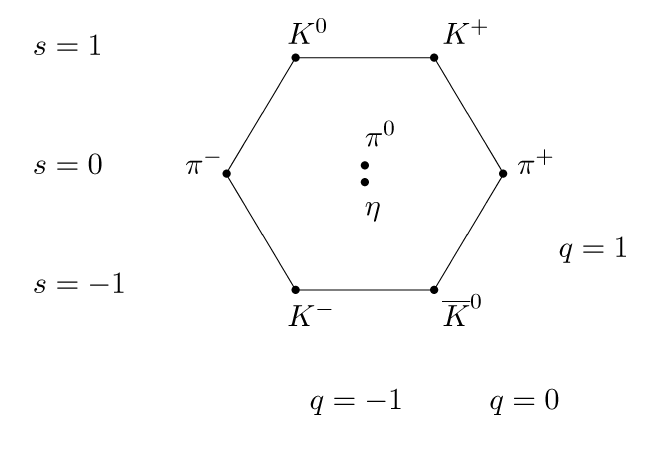
    A complex mechanism of interaction was done away with by Gell-Mann and Ne’eman, and substituted with one that brought to light simpler ones, all through a little bit of creativity and some geometry. The meson octet is well-known today because it brought to light a natural symmetry in the universe. Looking at the octagon, we can see it’s symmetrical across three diagonals that connect directly opposite vertices.

    The study of these symmetries, and what the physics could be behind it, gave birth to the quark model as well as won Gell-Mann the 1969 Nobel Prize in physics.

    What we perceive as philosophy, mathematics and science today were simply all subsumed under natural philosophy earlier. Before the advent of instruments to interact with the world with, it was easier, and much more logical, for humans to observe what was happening around them, and find patterns. This involved the uses of our senses, and this school of philosophy is called empiricism.

    At the time, as it is today, the best way to tell if one process was related to another was by finding common patterns. As more natural phenomena were observed and more patterns came to light, classifications became more organised. As they grew in size and variations, too, something had to be done for philosophers to communicate their observations easily.

    And so, numbers and shapes were used first – they’re the simplest level of abstraction; let’s call it “0”. Then, where they knew numbers were involved but not what their values were, variables were brought in: “1”. When many variables were involved, and some relationships between variables came to light, equations were used: “2”. When a group of equations was observed to be able to explain many different phenomena, they became classifiable into fields: “3”. When a larger field could be broken down into smaller, simpler ones, derivatives were born: “4”. When a lot of smaller fields could be grouped in such a way that they could work together, we got systems: “5”. And so on…

    Today, we know that there are multitudes of systems – an ecosystem of systems! The construction of a building is a system, the working of a telescope is a system, the breaking of a chair is a system, and the constipation of bowels is a system. All of them are governed by a unifying natural philosophy, what we facilely know today as the laws of nature.

    Because of the immense diversification born as a result of centuries of study along the same principles, different philosophers like to focus on different systems so that, in one lifetime, they can learn it, then work with it, and then use it to craft contributions. This trend of specialising gave birth to mathematicians, physicists, chemists, engineers, etc.*

    But the logical framework we use to think about our chosen field, the set of tools we use to communicate our thoughts to others within and without the field, is one: mathematics. And as the body of all that thought-literature expands, we get different mathematic tools to work with.

    Seen this way, which I do, I’m not reluctant to using equations in what I write. There is no surer way than using math to explain what really someone was thinking when they came up with something. Looking at an equation, you can tell which fields it addresses, and by extension “where the author is coming from”.

    Unfortunately, the more popular perception of equations is way uglier, leading many a reader to simply shut the browser-tab if it’s thrown up an equation as part of an answer. Didn’t Hawking, after all, famously conclude that each equation in a book halved the book’s sales?

    That belief has to change, and I’m going to do my bit one equation at a time… It could take a while.

    (*Here, an instigatory statement by philosopher Paul Feyerabend comes to mind:

    The withdrawal of philosophy into a “professional” shell of its own has had disastrous consequences. The younger generation of physicists, the Feynmans, the Schwingers, etc., may be very bright; they may be more intelligent than their predecessors, than Bohr, Einstein, Schrodinger, Boltzmann, Mach and so on. But they are uncivilized savages, they lack in philosophical depth — and this is the fault of the very same idea of professionalism which you are now defending.“)

    (This blog post first appeared at The Copernican on December 27, 2013.)

  • “God is a mathematician.”

    The more advanced the topics I deal with in physics, the more stark I observe the divergence from philosophy and mathematics to be. While one seems to drill right down to the bedrock of all things existential, the other assumes disturbingly abstract overtones, often requiring multiple interpretations to seem to possess any semblance of meaningfulness.

    This is where the strength of the mind is tested: an ability to make sense of fundamental concepts in various contexts and to recall all of them at will so that complex associations don’t remain complex but instead break down under the gaze of the mind’s eye to numerous simple associations.

    While computation theory would have us hold that a reasonable strength of any computing mechanism could be measured as the number of calculations it can perform per second, when it comes to high-energy physics, the strength lies with the quickness with which new associations are established where old ones existed. In other words, where unlearning is just as important as learning, we require adaptation and readjustment more than faster calculation.

    In fact, the mathematics is such: at the fringe, unstable, flitting between virtuality and a reality that may or may not be this one.

    One could contend that the definition of mathematics in its simplest form – number theory, fundamental theories of algebra, etc. – is antithetic to the kind of universe we seem to be unraveling. If we considered the example of physics, and the divergence of philosophy from theoretical physics, then my argument is unfortunately true.

    However, at the same time, it seems to be outside the reach of human intelligence to conceive a new mathematical system that becomes simpler as we move closer to the truth and is ridiculously more complex as one strays from it toward simpler logic – not to mention outside the reach of reasoning! How would we then educate our children?

    However, it is still unfortunate that only “greater” minds can comprehend the nature of the truth – what it comprises, what it necessitates, what it subsumes.

    With this in mind: we also face the risk of submitting to broader and broader terms of explanation to make it simpler and simpler; we throw away important aspects of the nature of reality from our textbooks because people may not understand it, or may be disturbed by such clarity, and somehow result in the search seeming less relevant to daily life. Such an outcome we must keep from being precipitated by any activity in the name of and for the sake of science.

    On Monday, I attended a short lecture by the eminent Indian particle physicist Dr. G. Rajasekaran, or Rajaji as he is referred to by his colleagues, on the Standard Model of high-energy physics and its future in the context of the CERN announcement on July 4, 2012. While his talk itself straightened a few important creases in my superficial understanding of the subject, two of its sections continues to nag at me.

    The first was his attitude toward string theory, which was laudatory to say the least and stifling to say the most. When asked by a colleague of his from the Institute of Mathematical Science about constraints placed on string theory by theoretical physics, Rajaji dismissed it as a political “move” to discredit something as exotic as the mathematical framework that string theory introduced.

    After a few short, stunted sniggers rippled through the audience, there was silence as everyone realised Rajaji was serious in his allegation: he had dismissed the question as some political comment! Upon some prodding by the questioner, Rajaji proceeded to answer in deliberately uncertain terms about the reasons for the supertheory’s existence and its hypotheses.

    Now, I must mention that earlier in his lecture, he had mentioned that researchers, especially of high-energy/particle physics, tended to dismiss new findings just as quickly as they were ready to defend their own propositions because the subject they worked with was such: a faceless foe, constantly shifting form, one moment yielding to one whim, one serendipity, and the next moment, to the other (ref: Kuhn’s thesis). And here he was, living his words!

    The second section was his conviction that the future of all kinds of physics lay in the hands of accelerator physics. That experimental proof was the sole arbiter for all things physical he summarised within a memorable statement:

    God is a mathematician, but even he/she/it will wait for experimental proof before being right.

    This observation arose when Rajaji decided to speculate aloud on the future of experimental particle physics, specially considering an observable proof of the existence of string theory.

    He finished ruing that accelerator physics was an oft ignored subject in many research centres and universities; now that we had sufficiently explored the limits and capabilities of SM-physics, the physics to follow (SUSY, GUT, string theory, etc.) necessitated collision-energies of the order of 1019 GeV (the “upgraded” run of the LHC in early to July 2012 delivered a collision energy of 8,000 GeV).

    These are energies well outside the ambit of current human capability. It may well be admitted at this point that an ultimate explanation of the universe and all it contains is not going to be simple, and definitely not elegant. Every step of the way, we seem to encounter two kinds of problems: one cardinal (particle-kinds and their properties) and metaphysical (why three families of particles and not two or four?).

    While the mathematics is “reconfigured” to include such new findings, the philosophy acquires a rupture, a break in derivability, and implications become apparent ex post facto.