Science, culture, complexity

Tag: laminar flow

  • A vortex in my bucket

    One of the taps in my bathroom at home issues water in laminar flow – without any turbulence. Sometimes the flow from the tap to the bucket looks like it’s frozen: there are no disturbances on the water’s surface to indicate that it is flowing through the air; the fact of the flow becomes evident only when it strikes the water already in the bucket.

    If the water in the bucket is otherwise still, i.e. undisturbed by any other jerking motion, the flow from the water seems to create a small depression when it strikes the surface, like a ball might create a depression when it lands on suspended fabric. But when I took a closer look, it was less a depression localised to the surface and more the origin of a vortex plunging into the water, like an underwater tornado!

    When I closed this magic tap and opened the one next to it, it gushed a turbulent stream of water into the bucket. There were no vortices, or none that I could see. I remember learning in engineering college that turbulent flow is characterised by the production of many vortices that all interact with each other in a chaotic way, creating a drag force that impedes the fluid’s smooth flow.

    Where there is a vortex, there is or will be turbulence. In this case, the laminar flow from the tap could be transitioning to a turbulent state as it flows into the still water, until at the bottom of the vortex the flow dissipates completely. Such a lovely sight.
  • A leap forward in ‘flow’ batteries

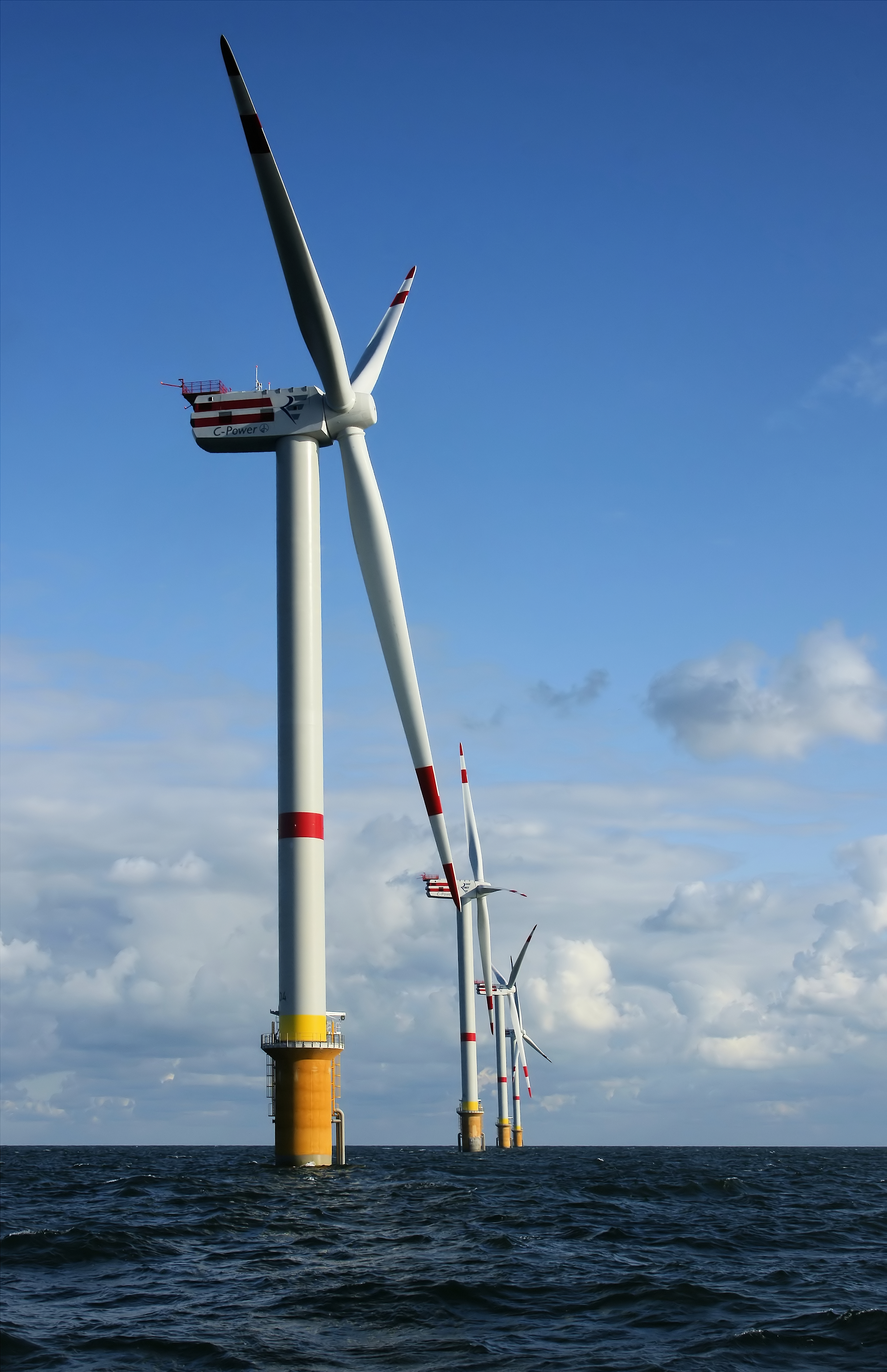
    Newly constructed windmills D4 (nearest) to D1 on the Thornton Bank, 28 km off shore, on the Belgian part of the North Sea. The windmills are 157 m (+TAW) high, 184 m above the sea bottom.
    Newly constructed windmills D4 (nearest) to D1 on the Thornton Bank, 28 km off shore, on the Belgian part of the North Sea.

    Polymer-based separators in conventional batteries bring their share of structural and operational defects to the table, and reduce the efficiency and lifetime of the battery. To circumvent this issue, researchers at the Massachusetts Institute of Technology (MIT) have developed a membrane-less battery, a.k.a. a ‘flow’ battery. It stores and releases energy using electrochemical reactions between hydrogen and bromine. Within the battery, bromine and hydrogen bromide are pumped in through a channel between the electrodes. They keep the flow rate really low, prompting the fluids to achieve laminar flow: in this state, they flow parallely instead of mixing with each other, creating a ‘natural’ membrane that still keeps the ion-transfer channel open. The researchers, led by doctoral student William Braff, estimate that the battery, if scaled up to megawatts, could incur a one-time cost of as little as $100/kWh. This is value that’s quite attractive to the emerging renewable energy economy. From a purely research perspective, this H-Br variant is significant also for being the first rechargeable ‘flow’ battery. I covered this development for The Hindu.